
There's a particular kind of quiet that settles over you at a Narmada ghat in the early morning. The bells haven't started yet, the mist is still sitting on the water, and somewhere a boatman is untying his rope for the first crossing of the day. If you've ever stood at one of these ghats, you already know why so many travelers end up planning a full narmada parikrama instead of just a single visit.
At Pravaah, we've spent years helping people plan trips along this river, and one question keeps coming up: which ghats actually deserve a place on the itinerary? Not every ghat is postcard-worthy, and not every stretch of the river holds the same weight of history or devotion. So here's an honest, on-the-ground guide to the ghats worth building your journey around — and how they fit into the larger story of the narmada parikrama.
The Narmada isn't just a river you look at from a bridge. It's a river you walk beside, bathe in, and circle on foot if tradition calls you to. Every ghat along its 1,300-odd kilometers carries its own local legend, its own temple, its own reason people show up before sunrise. That's what makes a narmada parikrama so different from a typical pilgrimage — it isn't one destination, it's a moving relationship with the entire river.
Before we get into which ghats to prioritize, it helps to understand that people approach this journey in very different ways. Some attempt the full narmada parikrama by foot, a commitment that can stretch over months. Others prefer a faster, more comfortable route by road, splitting the same distance into a shorter, guided trip — more on that further down.
Amarkantak in Madhya Pradesh is where the Narmada rises from a small kund, barely wide enough to call a spring. It doesn't look like the beginning of a mighty river, but that's exactly the charm. The Narmada Udgam temple complex here is the natural starting or ending point for anyone doing the full circuit, and most pilgrims treat it as sacred ground before setting off.
The ghats at Amarkantak are simple — no grand steps, no crowds of vendors — just stone platforms, a few temple bells, and the sound of water that hasn't yet grown into a river. If your trip includes even a partial stretch, this is worth the detour.
If there's one ghat that consistently surprises first-time visitors, it's Omkareshwar. The temple town sits on an island shaped, according to local belief, like the Om symbol itself, and the ghats here are some of the most photographed on the entire river. Boats cross constantly between the mainland and the island, and the steps leading down to the water are almost always busy with pilgrims performing their rituals.
Many travelers combine their main journey with a shorter omkareshwar parikrama, a circuit around the island that can be completed in a few hours rather than weeks. It's a good option if you want a taste of the parikrama experience without committing to the entire route. Locals will tell you that even this shorter omkareshwar parikrama is considered deeply meaningful, since the island itself is one of the twelve Jyotirlinga sites.
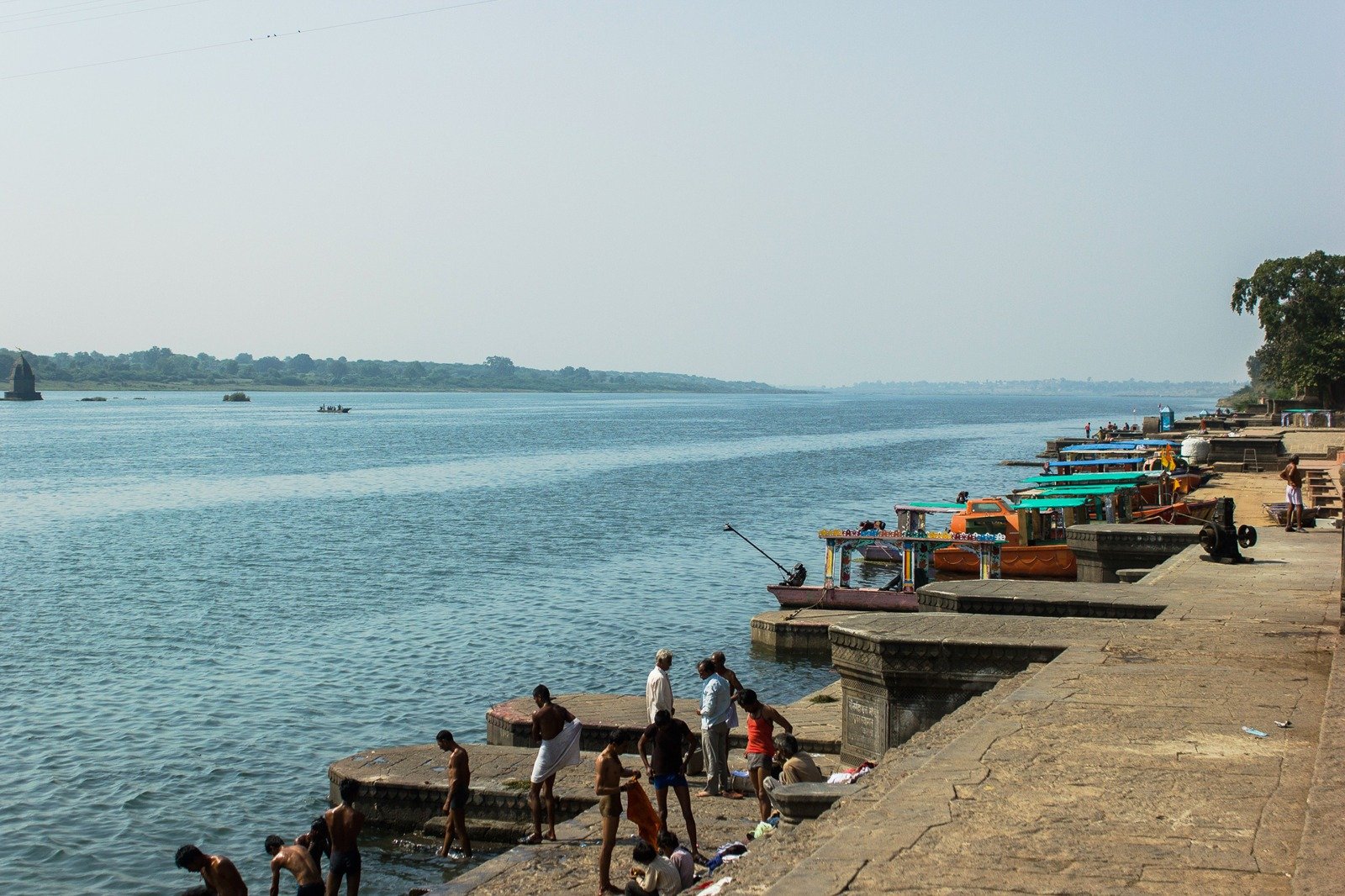
Maheshwar's ghats are unlike anything else on the river. Built by Rani Ahilyabai Holkar in the 18th century, they rise in tiered stone steps with carved pillars and small shrines tucked into every corner. The fort above overlooks the entire stretch, and in the evening, when the aarti lamps are lit, the reflection on the water is worth sitting for.
This is also where a lot of travelers base themselves for a day or two before continuing their route, since Maheshwar has decent stays and easy access to nearby temple towns.
Near Ferozpur and Barmanghat, there's a stretch where the Narmada briefly reverses its usual westward flow and moves north instead. This is the famous uttarvahini narmada parikrama zone, and it's considered one of the most auspicious short circuits along the entire river. Many devotees who can't manage the full 3,300-kilometer route choose to complete just this segment, believing it carries the same spiritual weight in a fraction of the distance.
The ghats along this uttarvahini narmada parikrama stretch are less commercialized than Omkareshwar or Maheshwar, which is part of the appeal. You'll find smaller temples, quieter mornings, and locals who are happy to explain the significance of the reversed flow if you ask.
Down in Gujarat, Bharuch marks the point where the Narmada widens dramatically before meeting the Arabian Sea. The ghats here feel different — broader, busier, shaped by tidal changes rather than mountain springs. The Bhrigu Rishi temple overlooks the river from a hill, and the view of the estuary at sunset is one of the most underrated sights on the whole route.
Kevadia, home to the Statue of Unity, is close by and worth combining with a Bharuch visit if your schedule allows.
Jabalpur offers something completely different — the Narmada cutting through white marble cliffs at Bhedaghat. Boat rides here glide right up against the rock walls, and the Dhuandhar Falls nearby add a dramatic stop before you continue downstream. The ghats in Jabalpur city itself are more urban but still active with daily rituals.
Once you've picked your ghats, the bigger decision is how to actually travel between them. This is where most people get stuck, so here's a quick breakdown.
By road: Several operators run structured circuits by bus or private car that cover all the major ghats over 10 to 15 days, with meals and stays bundled in. This is the more common choice for families and larger groups, since it covers the same ground in a fraction of the time and with far less physical strain.
On foot: The traditional and most demanding option is a narmada parikrama by foot, which can take anywhere from three to five months depending on pace and rest stops. Pilgrims doing this often rely on local dharamshalas and the generosity of villages along the way for food and shelter. It's not a trip for everyone, but for those who've done it, it's usually described as the most transformative version of the journey, and a well-planned narmada parikrama on foot is as much about the walk itself as it is about the ghats along the way.
Carry layers if you're traveling in winter months, since mornings at riverside ghats get genuinely cold. Footwear matters more than people expect — a lot of ghat steps are wet, uneven stone. And if you're doing any stretch of the parikrama on foot, even a short one, break in your shoes weeks in advance.
Photography is welcome at almost every ghat, but be mindful during active rituals; a quiet nod to ask permission goes a long way with both priests and pilgrims.
The Narmada doesn't reveal itself all at once. Each ghat adds a different layer — Amarkantak's stillness, Omkareshwar's crowds and devotion, Maheshwar's royal stonework, the quiet reversal at the Uttarvahini stretch, and Bharuch's wide, tidal calm. Whether you're planning the complete circuit or just a few of these stops, a well-planned narmada parikrama is less about ticking off locations and more about noticing how the river changes as you follow it.
If you're mapping out your own route, Pravaah can help you figure out logistics, timing, and which ghats deserve the most time on your itinerary.